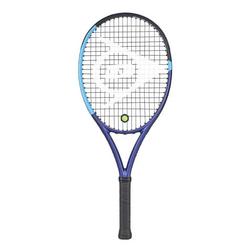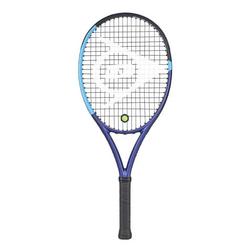


Few brands are as closely linked to the evolution of modern tennis as Dunlop. From wooden rackets in the early 20th century to today’s high-performance graphite frames, Dunlop has played a central role in shaping the game. Dunlop was founded by John Boyd Dunlop in 1889 after he developed the first practical pneumatic tyre. While the company began in rubber manufacturing, it quickly expanded into sporting goods — including tennis balls and rackets.
By the early 1900s, Dunlop had become a recognised name in tennis equipment, producing high-quality wooden rackets that were used in club and tournament play across Britain and beyond. Dunlop’s most iconic racket emerged in 1932: the Maxply Fort. It became one of the best-selling and most successful wooden rackets in history.
The Maxply Fort was famously used by Rod Laver, who achieved two calendar-year Grand Slams (1962 and 1969). During this era, Dunlop dominated professional tennis, with many major champions competing using its rackets.
As tennis technology evolved, Dunlop moved from laminated wood to graphite and composite constructions.
One of the most famous frames of this period was the Max 200G, used by John McEnroe and Steffi Graf. The injection-moulded graphite construction was revolutionary at the time, offering exceptional feel and control.
This era cemented Dunlop’s reputation as a serious performance brand capable of adapting to the modern power game.
![Dunlop FX 500 Tour Tennis Racket (2026) [Frame Only]](/images/product/thumbnail/10369893.jpg?98)

![Dunlop FX 500 Tennis Racket (2026) [Frame Only]](/images/product/thumbnail/10369898.jpg?98)
![Dunlop FX 500 LS Tennis Racket (2026) [Frame Only]](/images/product/thumbnail/10369803.jpg?98)
![Dunlop FX 500 Lite Tennis Racket (2026) [Frame Only]](/images/product/thumbnail/dunlopfx5002026.jpg?98)
![Dunlop FX 500 Super Lite Tennis Racket (2026) [Frame Only]](/images/product/thumbnail/10369913.jpg?98)